
It is 12 degrees outside, your furnace just quit, and the technician hands you a repair quote. Now you are wondering whether to spend the money or start shopping for a new system. The right answer depends on your furnace’s age, the cost of the fix, and a new Colorado rule that has changed what replacement looks like in 2026. This guide to furnace repair vs. replacement in Denver gives you simple rules so you can decide with confidence.
Should You Repair or Replace Your Furnace in Denver?
Repair your furnace if it is under about 10 years old and the fix is relatively minor. Replace it if it is 15 or more years old and the repair costs more than half of a new system, if the heat exchanger is cracked, or if breakdowns keep repeating. Between 10 and 15 years, the two rules below break the tie.
| Factor | Lean Toward Repair | Lean Toward Replacement |
| Furnace age | Under 10 years | 15 years or older |
| Repair cost vs. new system | Under 50% | Over 50% |
| Repair history | First breakdown | Repeated repairs in a short time |
| Heat exchanger | Intact | Cracked or corroded |
| Energy bills | Steady | Rising with no change in use |
| Plans for the home | Moving in a few years | Staying long term |
How Long Do Furnaces Last in Colorado?
Most gas furnaces last 15 to 20 years, and well-maintained units can reach 25. A long Colorado heating season and dry, dusty air keep furnaces working hard, so skipped filter changes and missed tune-ups can shorten that range. Here is a simple age guide:
- Under 10 years: Repair is almost always the better choice unless something major has failed
- 10 to 15 years: Apply the two rules below and start gathering replacement information
- 15 to 20 years: Lean toward replacement unless the repair is small and inexpensive
- Over 20 years: Replacement is usually the smarter move, because more failures tend to follow
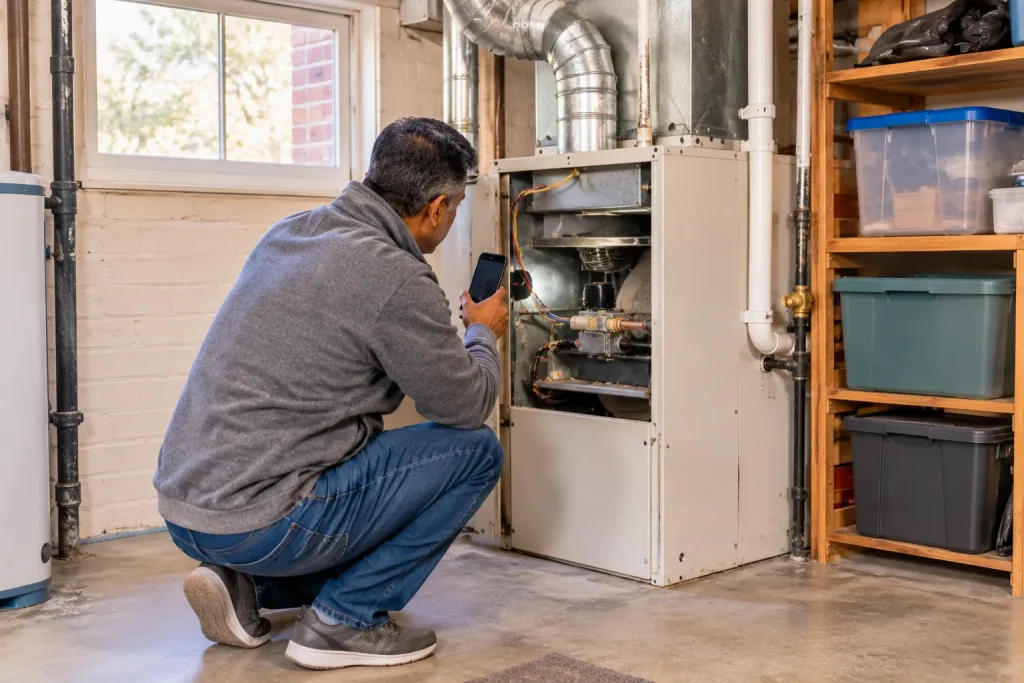
Not sure how old your furnace is? Check the model and serial number label inside the blower compartment door. The serial number usually encodes the manufacture date, and a technician can decode it in seconds.
The 50% Rule and the $5,000 Rule
Two rules of thumb help technicians and homeowners decide. They are not laws, but they work well as a starting point:
- The 50% rule: If a repair costs more than half the price of a comparable new furnace and your furnace is 15 or more years old, replace it.
- The $5,000 rule: Multiply your furnace’s age in years by the repair cost. If the result is above about $5,000, lean toward replacement.
For example, a 16-year-old furnace with a $350 repair scores 5,600, which points toward replacement. An 8-year-old furnace with a $450 repair scores 3,600, which points toward repair. These numbers are illustrations, not quotes.
Both rules only work with real numbers, so get the repair price and the replacement price in writing. If repairing is the better value for your home, we will tell you so.
Which Furnace Problems Are Worth Repairing?
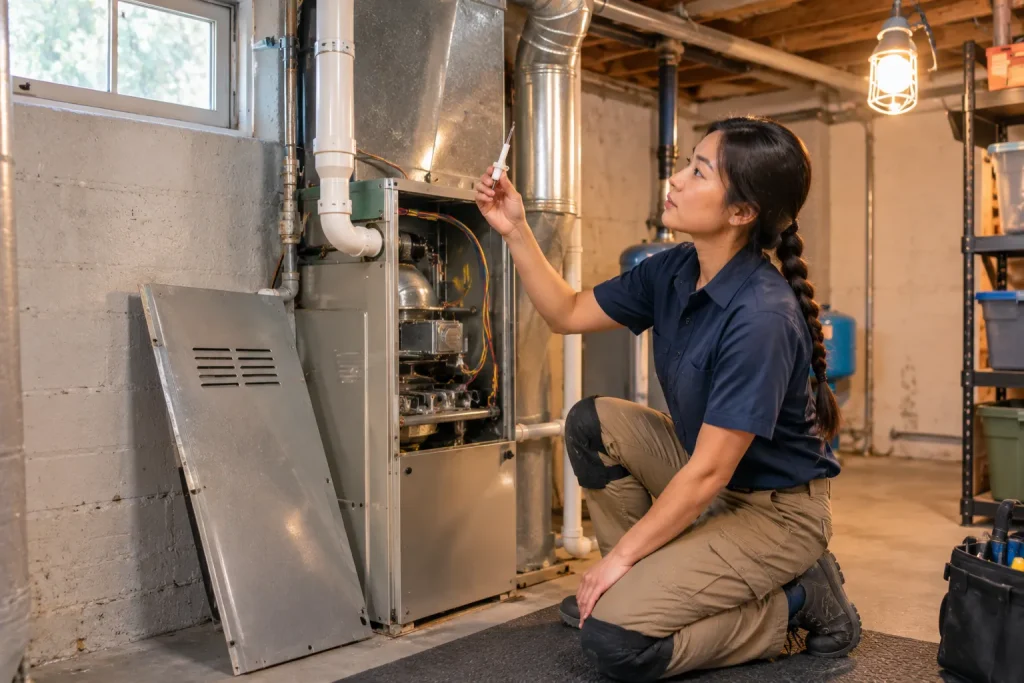
Small, inexpensive parts are usually worth fixing. Failures of the heat exchanger, or major components on an old furnace, usually are not. Here is how common problems tend to shake out:
| Problem | Typical Call | Why |
| Igniter, flame sensor, or thermostat | Repair | Low-cost parts that fail on furnaces of any age |
| Capacitor, inducer, or blower motor on a younger furnace | Repair | The rest of the system still has years of life left |
| Control board on a 15+ year furnace | Often replace | Other aging parts are likely close behind |
| Cracked heat exchanger | Replace | Can allow carbon monoxide into your home, and repair rarely makes sense |
| Frequent breakdowns | Replace | Repeated repairs add up and signal wear throughout |
If you smell gas or suspect carbon monoxide, leave the house immediately and call 911 or Xcel Energy from outside. Do not try to troubleshoot it yourself.
What Colorado’s 2026 Furnace Rules Mean for Replacement
Since January 1, 2026, new gas furnaces installed in Colorado must meet ultra-low NOx emission standards under House Bill 23-1161. In practice, that means high-efficiency condensing furnaces rated at about 95% AFUE or higher.
Your existing furnace is not affected. Repairs are still allowed, and you are not required to replace a working unit. What changes is the product and price when you do replace. Modern compliant furnaces typically cost more up front than the 80% efficiency models many homes have today, and they may need updated venting and a condensate drain.
In return, they waste far less fuel. A 95% AFUE furnace turns about 95 cents of every gas dollar into heat, compared with about 80 cents for an older standard model. Because replacement now costs more than it used to, the 50% rule can point toward repair a little more often than older advice suggests, though age and reliability still matter.
It also makes the heat pump conversation more interesting. A cold-climate heat pump or a dual fuel system, which pairs a heat pump with a gas furnace for the coldest nights, may be worth pricing alongside a new furnace. Learn more about our heat pump installation and repair services or our furnace installation and repair services.
Incentives have also shifted in 2026. The federal energy efficiency tax credit ended for equipment installed after December 31, 2025, and utility rebate programs have changed. Check our rebates and tax credits page for what is available now, and ask about financing options if you want to spread out the cost.
A 5-Step Checklist to Make the Call

- Find your furnace’s age. Check the serial number label inside the blower door.
- Get a written diagnosis and repair quote. Ask what failed and what else the technician noticed.
- Get a written replacement quote. You need both numbers to apply the rules.
- Run the 50% rule and the $5,000 rule. If both point the same direction, you have your answer.
- Think about the next 10 years. Consider how long you will stay, your energy bills, and whether a heat pump or dual fuel system fits your plans.
Frequently Asked Questions
How long does a furnace last in Denver?
Most gas furnaces last 15 to 20 years in Denver, and well-maintained units can reach 25. Annual tune-ups and regular filter changes are the two best ways to reach the upper end of that range.
Is it worth repairing a 15-year-old furnace?
Sometimes. If the repair is small and the furnace has been well maintained, fixing it can buy you several more winters. If the repair costs more than half of a new system, or the furnace has needed several repairs recently, replacement usually makes more sense.
Do I have to replace my furnace because of Colorado’s new law?
No. House Bill 23-1161 applies to new gas furnaces installed on or after January 1, 2026. Your existing furnace can keep running, and repairs are still allowed.
How much does a furnace replacement cost in Denver?
It depends on the furnace’s size and efficiency, your home’s venting and ductwork, and whether you choose a furnace, heat pump, or dual fuel system. We do not guess over the phone. After a free system analysis, our technicians give you a transparent written quote you can compare with the repair price.
Should I replace my furnace with a heat pump?
It depends on your home, ductwork, and goals. A cold-climate heat pump heats and cools from one system, and a dual fuel setup keeps a gas furnace as backup. We compare the options with real numbers so you can decide without pressure.
Get a Straight Answer on Your Furnace
You should not have to guess whether a repair is worth it. As a family-owned Denver company with 40+ years of combined experience, a 5.0-star Google rating from 575+ reviews, and Trane equipment backed by strong manufacturer warranties, we give you honest numbers and let you decide. Our drug-free technicians send text updates and arrive on time.
Schedule your free system analysis today. Book online at comfortpros.net or call us at 303-945-4319. We proudly serve Denver, Aurora, Boulder County, and surrounding Colorado communities.
